Cloudflare Now Detects MCP Traffic: Securing AI Agent Infrastructure
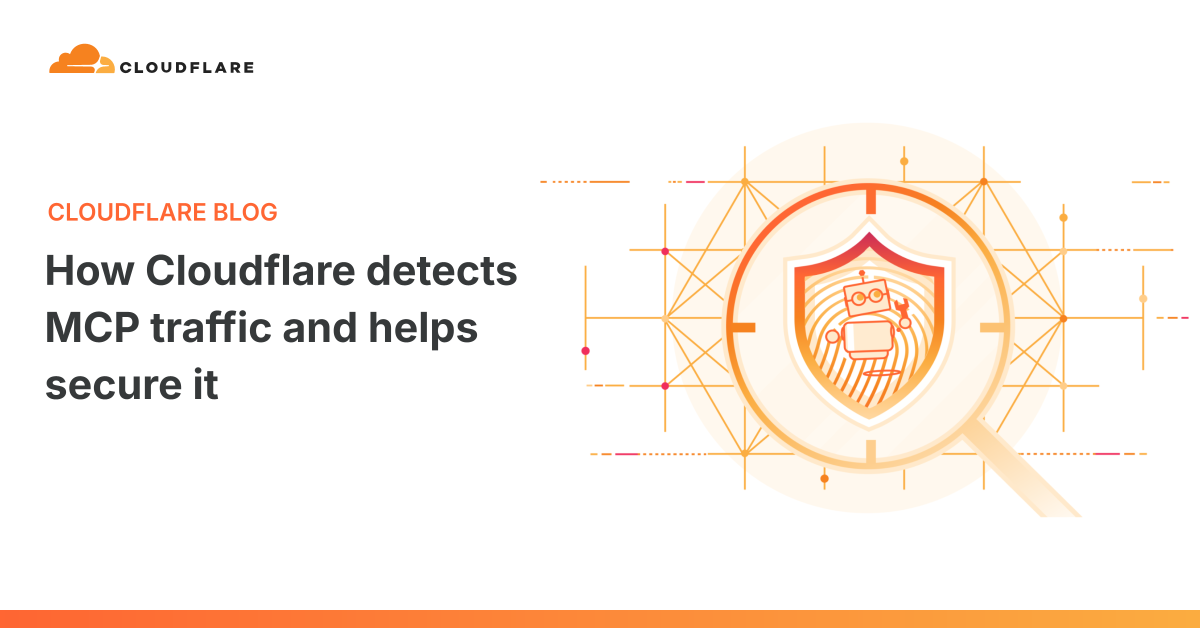
Cloudflare has announced that its Gateway service can now detect Model Context Protocol (MCP) traffic, giving security teams visibility into a rapidly growing category of network activity that has largely flown under the radar. The announcement, published on the Cloudflare blog on August 14, addresses a problem that is only beginning to register on the security community's radar: how do you secure infrastructure that is being driven by AI agents rather than humans?
MCP is an emerging standard that allows AI agents to discover and invoke tools — everything from SaaS applications and internal APIs to custom business logic. It is the connective tissue that lets an agent actually do things in the real world, rather than just generate text. But that capability comes with a significant security challenge: agents behave differently from humans, and the traffic they generate does not look like anything security teams are used to seeing.
The Problem With Agent Traffic
Traditional network security assumes a certain shape to traffic. Humans browse to known hostnames, use predictable protocols, and make decisions at human speed with human judgment. AI agents break all of those assumptions. They act non-deterministically, operate at machine speed, and make decisions without the kind of judgment a human would apply before, say, granting access to a sensitive system.
MCP traffic is also hard to identify by conventional means. There is no fixed hostname to blocklist, and the protocol does not require a specific path like /mcp in the URL. An agent could be talking to a legitimate MCP server one moment and a shadow service the next, and a naive firewall would see nothing unusual in either case.
How Cloudflare Detects It
Cloudflare's approach relies on protocol-level heuristics rather than simple pattern matching. The detection looks for telltale signs of MCP traffic, including the MCP-Protocol-Version and Mcp-Method headers, as well as the JSON-RPC structure that MCP uses under the hood. By inspecting the actual protocol rather than just the destination, Cloudflare can identify MCP traffic regardless of where it is going.
This capability enables two important use cases. The first is shadow MCP detection — finding unauthorized agent traffic that is flowing through your network without your knowledge. The second is MCP Server Portals, which allow organizations to enforce a policy of only approved paths and endpoints, blocking agents from reaching anything outside the sanctioned list.
Why This Matters Now
The rise of AI agents in the enterprise is happening faster than most security programs can adapt. Developers are wiring agents into internal systems, giving them credentials and tool access, and deploying them to production — often without a clear picture of what those agents are actually doing on the network. Cloudflare's MCP detection is an attempt to give security teams a way to see and control that activity.
Combined with Cloudflare One, the company's broader network-security platform, the MCP detection capability fits into a larger story about applying network-level controls to a new class of traffic. The message is that agent infrastructure needs the same kind of governance as any other part of the stack — visibility, policy enforcement, and the ability to say no.
What Should You Do?
Start by finding out whether MCP traffic is already flowing through your network. If you use Cloudflare Gateway, enable the MCP detection and review what it surfaces — you may be surprised by how much agent activity is already happening. If you are not a Cloudflare customer, look for equivalent visibility in your existing network monitoring tools, or consider whether your current stack can even see this traffic at all.
Next, establish a policy for AI agent access. Decide which MCP servers and endpoints are approved, and enforce that list rather than allowing agents to reach anything they can discover. Treat agent credentials with the same care you would apply to service accounts, and apply the principle of least privilege. The goal is not to block AI agents entirely, but to bring them under the same governance umbrella as the rest of your infrastructure.